
April 2026

Issue #9
The Executive Board
President
Chief Patrick Purcell
Westborough Fire Department
Immediate Past President
Chief Michael Kelleher
Foxborough Fire Department
1st Vice President
Chief Brian F. Nardelli
Brockton Fire Department
Secretary/Treasurer
Chief Kevin P. Partridge, Ret.
2nd Vice President
Chief Christopher Norris
Easthampton Fire Department
Message from the President
Dear Fellow Members of the Fire Chiefs Association of Massachusetts,
It has been one of the greatest honors of my career to serve as your President. As I prepare to step down on May 20th, I am filled with immense gratitude and pride for what we have accomplished together.
Over the past year we have worked together to move the fire service forward strengthening the bonds between our departments, improving relationships with the local and state leaders, and working to improve safety for our communities. I am incredibly proud of our work in the State House with our Legislators, our work supporting training and mental health initiatives, and our drive to keep Public Safety moving forward.
I want to extend my heartfelt thanks to the Board of Directors, the committees, and all of our members. Your dedication, hard work, and commitment to the fire service makes this organization strong. A special thanks to my family and to the members of the westborough Fire Department for their support and understanding during this commitment.
At theconclusion of my term, I remain committed to this mission of our organization and have full confidence in Chief Brian Nardelli and the incoming leadership team to continue the progress that we have all made.
Thank you for your trust, your partnership, and your dedication to the Fire Chiefs Association of Massachusetts.
Respectfully,
Patrick Purcell
President, FCAM
__________________________________________________________________
May General Membership Meeting- Installation of Officers
FCAM May General Membership Meeting & Installation of Officers: May 20, 2026, Thorny Lea Golf Club, Brockton
FCAM invites you to the Installation Ceremony for Fire Chief Brian F. Nardelli of Brockton, who will become the 104th President of our Association. The Executive Board and Board of Directors will also be sworn in. This Class A event includes the GMM at 10:00 am and Officer Installation at noon.
Meeting at the Thorny Lea Golf Club, 10 am, noon Installation of Officers. Thorny Lea Golf Club, 159 Torrey Street, Brockton. RSVP is requested by all who plan to attend. Deadline is May 13, 2026.

Please update your contacts and begin to use the following emails for FCAM:President: president@fcam.org
secretary@fcam.org
board@fcam.org
Upcoming Meetings & Trainings
-
FCAM General Membership Meeting - The Manor Banquet Facility
October 21, 2026
10:00 am - 5:00 pm
The Manor Banquet Facility
FCAM General Membership Meeting October 21, 2026 1000 hours The Manor Banquet Facility 42 W. Boylston St. West Boylston (more…)
-
FCAM General Membership Meeting - Hosted by NFPA, at Marriott Boston Quincy
November 18, 2026
9:00 am - 5:00 pm
Marriott Boston Quincy
FCAM General Membership Meeting November 18, 2026 0900 – Coffee with Vendors 1000 – meeting noon Lunch RSVP required 1000 Marriott Drive, Quincy (more…)
Monthly Highlights
FCAM host Indoor Tracking Summit at April meeting in Auburn
Past President Peter Burke Jr. welcomed FCAM members to the summit and introduced key technology partners: NextNav, Critical Response Group (CRG), esri, and FirstDue. Presenters included Kevin Roche, who discussed the Charleston Sofa Superstore Fire, and Commissioner Joe Finn (Ret.) of the Boston Fire Department, who reviewed the Beacon Street fire. Both focused on the difficulties in locating missing firefighters and stressed the importance of indoor tracking solutions. The day concluded with a panel featuring Commissioner Finn, Brockton Chief Brian Nardelli, Worcester Chief Martin Dyer, and facilitator Hyannis Chief Peter Burke. The work continues to produce a solution, and we thank our technology partners for their effort.

In Memoriam
Retirement Well Wishes
Fire Chief Patrick Egloff, Westfield Fire Department
FCAM Welcomes
Fire Chief Manuel Rose, Chilmark Fire Department
Fire Chief Joseph Rock, Pepperell Fire Deprtment
Fire Chief David Toto, Methuen Fire Department
Deputy Chief Thomas Graham, Woburn Fire Department
Deputy Chief Matthew Carroll, North Reading Fire Department
Assistant Chief Eric Tarpy, Haverhill Fire Department
Deputy Chief Joshua Benoit, Fairhaven Fire Department
Assistant Chief Robert Cavender, Manchester by the Sea Fire Department
Important Notes
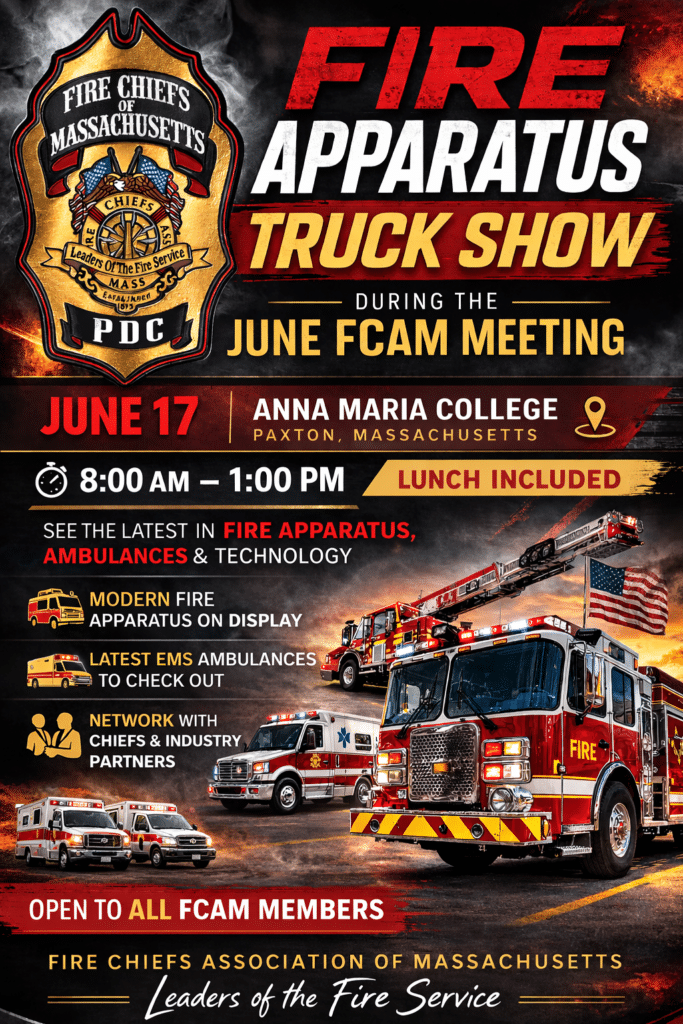
June 17 General Membership Meeting, Mini Vendor Show, 8:00 am- 1:00 pm, please join us a thank our vendors for all there support
DEA Compliance Question with Controlled Substances Act
The 2026 rule from the Drug Enforcement Administration represents a significant shift in how EMS agencies manage controlled substances, moving the industry from a loosely defined framework into one of clear, enforceable accountability under the Controlled Substances Act. For the first time, EMS agencies are formally recognized as distinct entities that can register directly with the DEA, rather than operating solely under a hospital or physician license. This change places full responsibility for narcotics control, documentation, and security directly on the agency itself.
At the core of the new rule is the expectation that every controlled substance can be tracked throughout its entire lifecycle. Agencies must be able to demonstrate who handled the medication, where it was stored, how it was transferred, and what ultimately happened to it—whether it was administered, wasted, or disposed of. This level of oversight requires more than basic recordkeeping; it demands a system in which all documentation is accurate, complete, and immediately retrievable. In an audit, the ability to quickly reconstruct the history of a single vial is no longer ideal—it is expected.
Operationally, the DEA has introduced a hub-and-spoke model that reshapes how EMS systems distribute narcotics. A central registered location, typically the agency headquarters, serves as the legal point of receipt and primary control site. From there, medications are distributed to designated locations such as stations, ambulances, or satellite facilities. While these secondary locations do not require separate DEA registration, they must still operate under strict tracking and documentation standards. Any movement of controlled substances between locations must be recorded, reinforcing a continuous and verifiable chain of custody.
Documentation requirements have become more comprehensive and more critical to compliance. Agencies must maintain detailed records for ordering, inventory, transfers, administration, and waste, as well as procedures for reporting theft or loss. However, compliance is not achieved
simply by having these records—it depends on consistency and reconciliation. Inventory counts must align with administration reports and restocking logs, and discrepancies must be identified and resolved immediately. Delayed or incomplete documentation is now considered a significant
compliance risk.
Security expectations have also been elevated. The DEA requires that controlled substances be stored in secure, tamper-resistant environments with access limited to authorized personnel. This typically involves the use of reinforced safes, controlled access systems, and layered security measures, particularly within response vehicles. Simply securing narcotics inside an ambulance is no longer sufficient; agencies must demonstrate that access is both restricted and traceable.
The greatest risks under this new framework remain internal diversion, inconsistent documentation practices, and a lack of system-wide visibility, especially in multi-station or
decentralized EMS systems. These risks are compounded when agencies fail to align federal requirements with state-specific regulations, such as those that may still apply in places like
Massachusetts.
Ultimately, the 2026 DEA rule is not just a regulatory update; it is an operational mandate. EMS agencies must now function with a level of control and accountability comparable to other highly regulated healthcare entities. Success under this model depends on strong policies, consistent training, effective oversight, and, where appropriate, the integration of technology to support tracking and documentation. Agencies that adapt to this framework will not only meet compliance expectations but also strengthen the integrity and safety of their operations.
FCAM sent an email to the Massachusetts Controlled Substance Registration (MCSR) on March 30, 2026, asking whether ambulance services had to register with the DEA under these new guidelines. The response from Traci Westgate from MCSR, on that same day, stated, “Since most ambulance services in Massachusetts have medical directors and affiliation agreements with hospitals to obtain their federally scheduled drugs, these services would not be required to obtain a DEA, but it is optional. The Commonwealth of Massachusetts does not require the DEA and I do see us ever requiring it as this would cause a lot of burden on these ambulance services.”
In short, agencies do not have to register with the DEA as they are covered under their affiliation agreements with the hospital through their ambulance license.
Here is a link to the most recent webinar outlining these updates for those who may be
interested: https://www.youtube.com/watch?v=-tPTEstsupc
Legislative Priorities 2025–2026
The effort to move OEMS from DPH to EOPSS is still receiving a lot of attention. President Purcell has met many times with EOPSS Secretary Kwan to inform her of the need and reasons for the move. The Ambulance Coalition had a zoom meeting last Friday to discuss strategies to keep the Bill moving
The House Budget has been released – it cut the funding request for the On-Site Academy by $1.5 million from last year. Representative Jon Zlotnik has filed an Amendment to restore the funding. There has been 100 earmark Amendments filed for local Fire Departments
The House version of the Ambulance Reimbursement/Patients Rights Bill has been reported out of the Joint Committee on Health Care Finance favorably and sent to the House Ways and Means Committee. The Senate version was reported favorably earlier.
On the Federal side, the Bill for the reauthorization of the FirstNet that we spoke on in Washington has passed the House and will be sent to the Senate. The US Fire Administration, US Fire Academy and most of FEMA are still shut down due to the funding battle.
FCAM History
FCAM Board of Directors 1993-1994 Remembering those who served in the past
| President | Chief James N. Russo | Hull |
| 1st VP | Chief Ronald Cormier | Leominster |
| 2nd VP | Chief Robert DiPoli | Needham |
| Secretary/Treasurer | Chief James M. Hallisay (Ret.) | Brockton |
| District 1 | Chief John Farrington | Centerville |
| District 2 | Chief John Parow | Chelmsford |
| District 3 | Chief George Burgess | Norton |
| District 4 | Chief Robert Skinner | Plainville |
| District 5 | Chief Walter Newbury | Saugus |
| District 6 | Chief Tomas Ryan | Tewksbury |
| District 7 | Chief Roger Belhumer | Auburn |
| District 8 | Chief Edward Oberg | Holden |
| District 9 | Chief Richard Morin | Turners Falls |
| District 10 | Chief Victor Zumbruski | Amherst |
| District 11 | Chief Frank O’Brien | Westfield |
| District 12 | Chief James Tobin | Pittsfield |
| District 13 | Chief Tom Gorman | Quincy |
| District 14 | Chief Thomas Garrity | Hudson |
| District 15 | Chief James Clarke | Methuen |

